Carbohydrate gliders are little marsupials that take become more mutual to breed and own every bit pets over the last decade. They are native to Australia and are primarily wildlife. In captivity, breeders tin cross sugar gliders to reproduce stunning and visually unique patterns and color combinations.
Beneath are the standard colors and rare genetic crosses that you might get when crossing specific sugar gliders.
Typically, a sugar glider starts with a type of predominant coloration, and variances from there grade the diverse patterns that they can have. Standard grays are good examples of this considering they have iv variations from one prepare color.
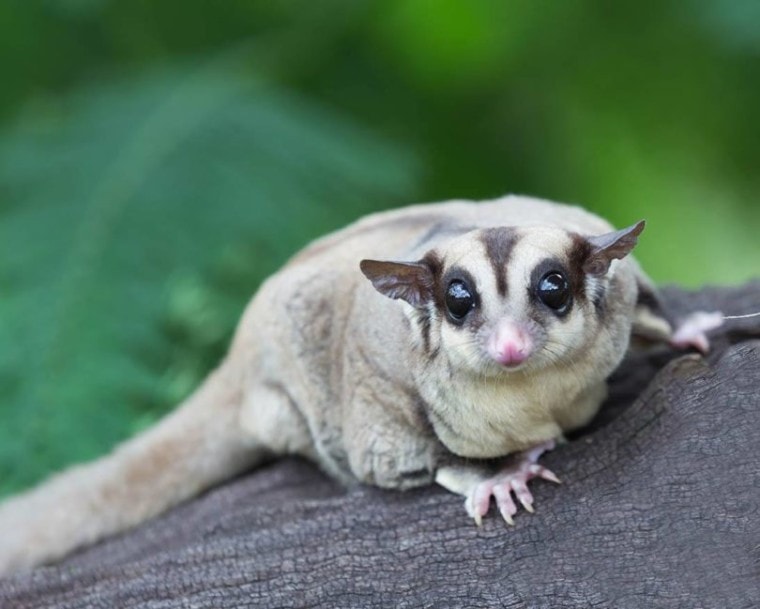
Standard grayness saccharide gliders are the most mutual kinds of sugar gliders. These are what you volition typically picture when you call up of the animals. A grey sugar glider has shades of grayness and a dark black or brown stripe that runs from the betoken of their nose to the beginning of their tail.
The standard grey color and design is a dominant gene that volition display over the other colors when crossed with other varieties of gliders. They might bear that gene and have a hazard of reproducing a unlike colour pattern, only they do not express that color themselves.
The eighteen Standard Gray Sugar Glider & the Variations
1. Black Beauty Saccharide Glider
The Black Beauty variation of the Standard Gray has typical coloration and patterns only is overall several tones darker than the usual standard greyness. It is difficult to brood for this variation and primarily seems to be random.
These sugar gliders have dark rings around their eyes, sometimes referred to as their "eyeliner." The line running downward their body is black, and even their tum is a darker tone. They will take black knuckles and a black chin strap that runs from their ears to their eyes and downward.
two. Cinnamon Sugar Glider
Cinnamon-colored saccharide gliders are a lighter cinnamon-brownish tone with a standard gray color pattern. They take a brown-reddish tint all over their body.
Although this tin be a cute color pattern, it is often the consequence of a bad nutrition that manifests as a fur discoloration over their entire torso. Even the fur on their breadbasket will get red or yellow-tinted.
3. King of beasts Saccharide Glider
Panthera leo saccharide gliders are similar to the standard grey merely with a honey-colored tint to their fur. They are also anatomically dissimilar most of the fourth dimension. These gliders often have a shorter nose on a more rounded face, role of which gives them the name "Lion."
You can also detect a white face variety of a lion sugar glider. They might not have the same rounded face and shorter olfactory organ that the typical lions practice.
four. White Tip Sugar Glider
White tip sugar gliders are not always thought of to be a variation of the standard greyness, but they are primarily grey and have the same pattern across their heads and bodies. The difference is the white tips on the ends of their tails. It tin exist an inch up to one-half of their tail length. It is a recessive gene and can exist challenging to brood.
Mosaic Sugar Glider and the Variations
Gliders with mosaic patterns have a broad variety of designs and colors that assemble at random on the sugar glider.
There are quite a few variations of a mosaic that breeders endeavor to selectively brood. Withal, at that place is not much evidence that it is possible to breed for a specific mosaic trait. Sure lines and markings accept a higher charge per unit of transferability than others.
Whatever the case for breeders, there are typical mosaic patterns that you volition find on saccharide gliders instead of entirely randomized patterns and colour combinations.
five. Piebald Saccharide Glider
Piebald sugar gliders have a mosaic pattern that can exist totally random and asymmetrical only will ever accept varying spots that are completely unpigmented. They have these large white splotches all over their bodies, and these are oft assorted by nighttime blackness spots or stripes. The skin underneath these various color patterns will be pigmented according to the fur pattern on top.
6. True Platinum Mosaic Saccharide Gliders
In that location are saccharide gliders with particular "true platinum" genetics and an overall mosaic blueprint. They tin can have diverse other colors and patterns, but they will have those pure platinum genes and colorations on their trunk. They virtually always have the typical mosaic characteristics, including the white collar around their cervix and a ringed tail.
7. Silver Mosaic Carbohydrate Gliders
These saccharide gliders can have a patchwork of light silver-colored fur. They are oftentimes called platinum mosaic gliders, even though they practice not have whatever platinum genetics.
eight. White Mosaic Saccharide Gliders
The white mosaic sugar glider has predominantly white fur with color variations that are all quite lite. They might accept minimal dark spots, primarily on their ears or their heads. They often look like a leucistic saccharide glider, simply they will not e'er accept leucistic genetics. The difference between leucistic and white mosaic sugar gliders is that they take to exist born virtually entirely white.
ix. Band Tail Sugar Glider
A band tail mosaic glider tin can accept a wide variety of patterns on the torso, whereas the tail has rings of colors from beginning to end. The colors are often a variety of grays, blacks, whites, and silvers.
10. Mahogany Blood-red Sugar Gliders
Mahogany reds accept a similar blueprint and markings to that of the standard grayness, only with tinted cherry-red and chocolate-brown colors throughout their body.
These gliders can take albino, white face, and mosaic variations. They can as well accept a cedar red color pattern that is a bit darker than a mahogany red glider.
11. Leucistic Saccharide Glider
Leucistic sugar gliders have interesting genetics that can be used to reproduce another leucistic glider with the same recessive genes and be integrated with other recessive characteristics and encourage those traits.
Their fur is solid white without any stripes, facial bars, or caput triangles. They volition accept black eyes and pink noses and toes.
12. Creamino Carbohydrate Gliders
Creamino sugar gliders are an all-over creamy color. The stripe on the center of their body is tawny dark-brown. They take garnet-colored eyes.
To brood a Creamino sugar glider, you take to cross two gliders expressing the same colorations, since it is a recessive factor.
thirteen. Platinum Sugar Glider
On true Platinum sugar gliders, the fur is light silver. Their stripe can be a low-cal grey to taupe color. It is often narrower than on other sugar gliders, focusing on the platinum colour of the body.
The other features on platinum sugar gliders frequently include white paws. This color is besides a recessive gene and needs to be bred with another sugar glider expressing the same gene. Interestingly, a sugar glider with a leucistic factor tin can reproduce with a platinum to reproduce some other platinum.
14. White Face up and White Confront Blonde Sugar Glider
White face sugar gliders have like color patterns to that of the standard gray. The significant divergence is the absence of the facial markings, primarily the mentum bar from their ear toward their chin.
The white face can exist a characteristic that tin be bred in with almost any other coloration or pattern. It is a dominant gene, and only one sugar glider in a pair needs to take the trait for it to reproduce in their offspring. If the saccharide glider joeys do not have the white face up expressed, they have not inherited the gene and will never reproduce other white face sugar gliders.
White confront blonde is a slight variation in the overall characteristic. The fur on their tummy and their face will take a golden hue. This gene is dominant.
xv. Melanistic Saccharide Glider
Melanistic sugar gliders are the contrary of albino gliders. Their pare and fur are all tinted a night pigment. The condition results in an abnormally high concentration of melanin in every part of the brute. Not all breeders concur that melanistic gliders even exist, nonetheless, saying instead that they are a variety of blackness beauty gliders.
16. Albino Saccharide Glider
As in any other animal, albino sugar gliders have no paint in their skin or fur. They have stunning red eyes. Sometimes, they can be born with a faint pigmentation forming as a triangle on their head or making up some of a stripe along their back. It is oftentimes a faint yellow color.
To reproduce an albino glider, you must pair ii albino gliders together considering it is a highly recessive cistron.
17. Ruby Leu or Double Recessive Sugar Glider
Carmine leu gliders have a combination of two colour patterns that are recessive inside one glider. They have a solid white color with red eyes that brand them look similar to albino gliders.
Many combinations tin be used to reproduce a Crimson Leu color, even though it is challenging to brood. These could be creamino and albino, an albino and leucistic, creamino and leucistic, creamino and platinum, and albino and platinum.
18. Caramel Saccharide Glider
Caramel sugar gliders are thought to be a subspecies of sugar gliders, with a body that is about twenty% larger than the traditional glider species. They too take larger ears than other gliders.
The caramel glider has a caramel-colored body with white easily and a cream-colored face. They can also have varying shades of greyness.
Interesting in learning more than nigh sugar gliders? Check out these!
Featured Paradigm Credit By: KAMONRAT, Shutterstock





0 Response to "How To Draw A Cute Sugar Glider"
Post a Comment